1 AI Employee, 5 Automations, $299/Month: The 2026 Local Business Playbook
An AI employee for local business is a set of automated tools — a chatbot, a voice receptionist, and a follow-up system — that runs a small business’s customer communication around the clock for a flat monthly fee, often around $299.
That single sentence describes a shift that is already changing how small businesses operate in 2026.
Plumbers, electricians, real estate agents, and mortgage brokers are quietly adopting AI employees to handle the work they don’t have time for.
And the businesses selling access to these AI employees are often just one person with a laptop.
This article breaks down exactly how the AI employee model works, who it’s built for, and how you can start offering it, step by step, without needing to be a developer or a marketing expert.
We strongly recommend that you check out our guide on how to take advantage of AI in today’s passive income economy.
Table of Contents
What Is an AI Employee, and Why Local Businesses Need One
An AI employee is not a robot or a physical worker.
It’s a set of connected AI tools that handle tasks a human employee would normally do: answering calls, replying to messages, booking appointments, and following up with leads.
For a local business, this matters because most owners are doing this work themselves, late at night, between jobs, or not at all.
Research consistently shows that roughly 3 in 10 small local businesses still don’t have a website in 2026, and a large share of incoming calls to small businesses go unanswered during business hours.
That gap is exactly where the AI employee model lives.
Instead of pitching a business owner on “digital marketing,” you’re offering something concrete: a free website first, then a simple AI employee upgrade that captures the leads they’re currently losing.
This approach works because it solves a problem the business owner already knows they have, rather than trying to convince them they need something new.
👉Free download: Start a 1-Person Business With Claude AI — Free Quick-Start Guide
Why the Free Website Is the Entry Point
The free website isn’t the product. It’s the icebreaker.
Business owners are naturally cautious about new sales pitches, especially ones involving AI.
But a free, already-built website removes the risk entirely, because there’s nothing to lose by looking at it.
Once they see their business name, their real contact details, and their actual service area already filled in, the AI employee upgrade becomes a much easier next conversation.
This two-step approach — free value first, paid upgrade second — is a well-established sales pattern, and it works especially well with small business owners who are busy and skeptical of cold outreach.
How the AI Employee Prospecting Process Works
Finding businesses without a website used to mean manually scrolling through Google Maps listings one at a time.
That process is slow, and it doesn’t scale past a handful of leads per hour.
A more efficient approach uses AI to search a target area — for example, plumbers in a specific city — and automatically filters out the businesses that already have a website, leaving only genuine prospects.
For each business, you can pull their name, phone number, address, current Google rating, and their Google Business Profile link, all in one pass.
From there, an AI tool can auto-generate a simple demo website using the business’s real name and contact details, so the outreach message is fully personalized before you ever pick up the phone.
This is the first real application of an AI employee in this business model: it does your prospecting and demo-building work for you.
👉Get Access to the full Package: Start a 1-Person Business With Claude AI
The Outreach Script That Gets Replies
Once you have a business’s contact details and a pre-built demo, the outreach message is simple and direct.
Something like: “I was looking for [service] providers in [city] and noticed you don’t have a website, so I went ahead and built one for you — want to see it?”
This works over a phone call, and it works just as well as a text follow-up, which matters because a large percentage of small business owners don’t answer calls from unknown numbers.
The goal of this first message isn’t to sell anything. It’s to get a “yes, show me.”
Once they say yes and see the free website, most owners are genuinely surprised at how personalized and professional it looks, and that’s the moment to introduce the AI employee upgrade.
What the Paid AI Employee Upgrade Actually Includes
This is where the $299-a-month offer comes in, and where the AI employee for local business model earns its name.
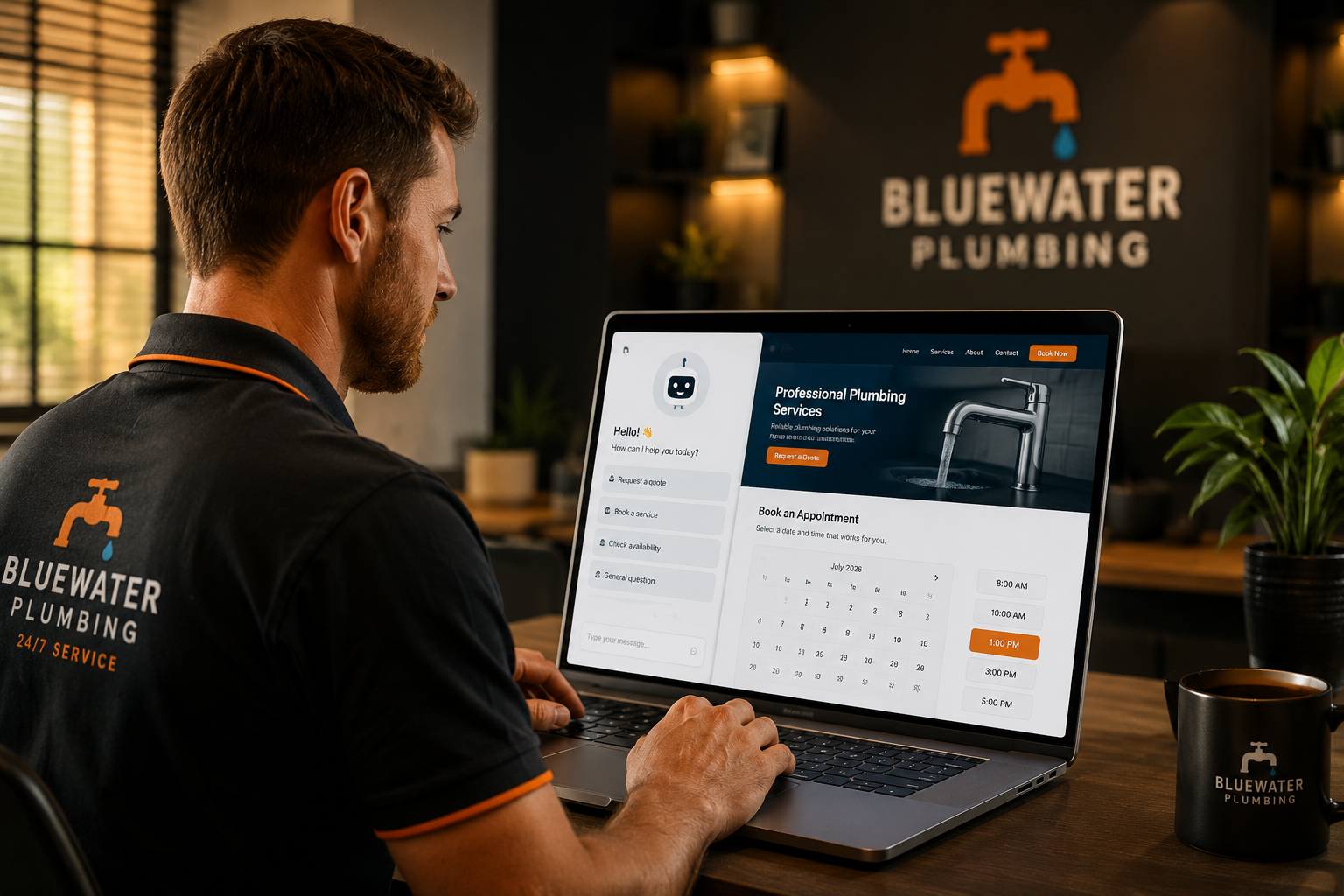
The upgrade typically includes an AI chat widget on the website, a voice AI receptionist that can answer and route calls, an automated missed-call text-back system, review request automation tied to the business’s Google Business Profile, and a unified inbox pulling in messages from email, text, and social platforms.
Setting all of this up manually for a client used to take hours of configuration.
With modern AI employee platforms, this same setup — creating the client account, building the site, configuring the chat widget, activating the voice receptionist, and building the review automation — can be completed in well under a minute once the workflow is built.
That speed is the actual leverage in this business: you’re not billing for your time, you’re billing for outcomes the AI employee delivers around the clock.
👉Free download: The Claude AI Digital Product Starter Pack — 10 Done-For-You Prompts for Beginners
Why the Missed-Call and Review Pieces Matter Most
Two parts of the AI employee stack tend to convert the fastest for local businesses: missed-call text-back and review automation.
Missed-call text-back solves an obvious problem — when a business misses a call, most callers just move on to the next competitor instead of leaving a voicemail.
An AI employee can automatically text that caller within seconds, keeping the conversation alive instead of losing the lead entirely.
Review automation works similarly. Most satisfied customers never think to leave a Google review unless someone asks them directly.
An AI employee can send a simple follow-up text or email after a completed job, asking for a review, which steadily increases both the number and quality of reviews without any extra effort from the business owner.
Neither of these requires fabricating reviews. It simply prompts real customers who already had a good experience to say so publicly.
Setting Your Price for the AI Employee Offer
There’s no single fixed price for this offer, and that’s actually an advantage.
Some operators charge $299 a month per client, others charge $500, and some charge as much as $1,500 a month depending on the market and the business type.
The right price depends on what the local market can support and how much value the automation delivers compared to hiring a part-time employee, which usually costs far more than any of these price points.
A useful way to think about pricing: if the AI employee is replacing tasks that would otherwise require a receptionist, a follow-up assistant, and a review manager, then $299 a month is often positioned as a fraction of what those roles would cost separately.
That framing — “less than one hour of a part-time employee’s wage per week” — tends to resonate with business owners far more than talking about “AI” or “automation” as abstract concepts.
Getting Started as a Solo Operator
You don’t need to be a developer, a designer, or an AI expert to offer this service.
What you do need is a repeatable process: find businesses without a website, offer the free build, upgrade them to the AI employee package, and deliver consistent results so they stay subscribed month after month.
For anyone building this as a one-person business, Claude can genuinely handle much of the heavy lifting — drafting outreach scripts, writing onboarding emails, building simple website copy, and helping structure your offer and pricing tiers.
👉Get Access to: The AI Blog Monetization Quickstart Guide
If you’re documenting this process as content — for your own audience or as a lead magnet for local clients — the same AI employee approach applies to your content business too, using AI to research, draft, and publish faster than doing it manually.
Avoiding the Most Common Early Mistake
The biggest mistake new operators make with the AI employee model is trying to build everything from scratch — custom code, custom design, custom automation logic — before landing a single client.
That approach burns weeks of time on a business model that hasn’t even been tested with a real prospect yet.
A faster path is to prove the offer works with a handful of real conversations first, using existing AI tools to handle the technical setup, and only refining your process once you have paying clients giving you feedback.
This mirrors how most successful one-person AI businesses actually start: prove demand first, build systems second.
👉Free download: Start a 1-Person Business With Claude AI — Free Quick-Start Guide
Why This Model Works Better Than Starting From Scratch
The reason the AI employee model appeals to beginners is that almost every variable is already known.
The target market is known: local businesses without a website.
The price range is known: roughly $299 to $1,500 a month depending on positioning.
The offer is known: a free website followed by an AI employee upgrade that solves a real, visible problem.
Compare that to building a completely new product for an unproven market at an unproven price, which is a much harder starting point for anyone new to online business.
Starting with a proven model doesn’t mean skipping the work. It means spending your early effort on outreach and delivery instead of guessing what the market wants.
Final Thoughts on Building Your First AI Employee Offer
The AI employee model for local business isn’t complicated, but it does require consistency: steady outreach, a clean onboarding process, and real follow-through once a client says yes.
Missed calls, slow follow-ups, and no online presence are problems nearly every local business owner already knows they have, which makes this one of the more straightforward AI offers to sell in 2026.
If you’re planning to build this as a repeatable business rather than a one-off project, it’s worth setting up your outreach scripts, pricing tiers, and delivery process before you make your first call.
👉Get Access to the full Package: Start a 1-Person Business With Claude AI
👉Get Access to: The AI Blog Monetization Quickstart Guide
👉Free download: The Claude AI Digital Product Starter Pack — 10 Done-For-You Prompts for Beginners
Building an AI employee for local businesses isn’t about chasing a trend. It’s about solving a problem that’s been sitting in plain sight for years — and finally having the tools to solve it at scale.
We strongly recommend that you check out our guide on how to take advantage of AI in today’s passive income economy.