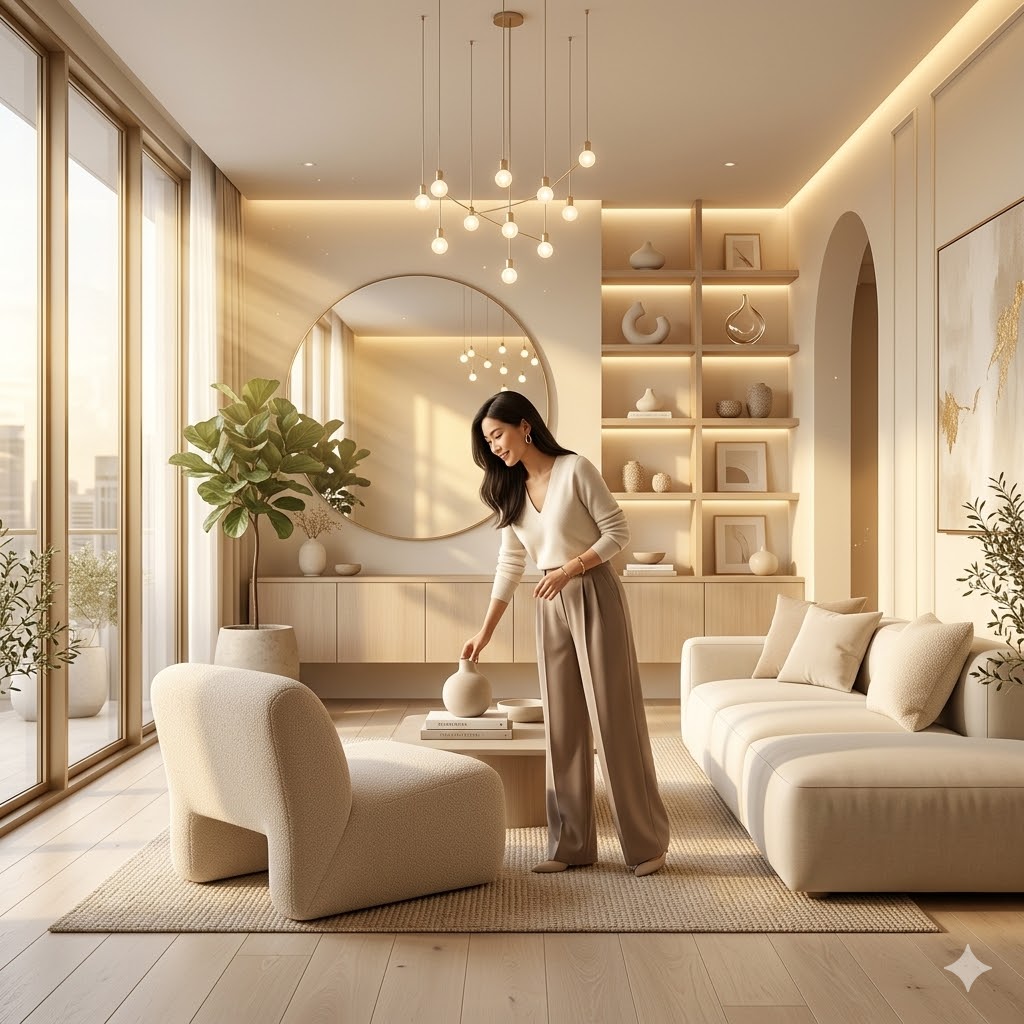
12 Minimalist Room Design Ideas Designers Use to Style Small Rooms on a Budget
Small Rooms Can Look Like a Million Dollars
Minimalist room design ideas for small spaces are changing the way people think about decorating in 2026, and the results are quietly spectacular.
Gone are the days when a tiny room had to feel cramped, forgettable, or visually noisy.
Today, some of the most beautiful interiors in the world belong to compact rooms that have been styled with intention, restraint, and a clear sense of calm.
Picture walking into a room where everything feels light, open, and perfectly placed.
The bed is crisp and layered, the walls are clean but not cold, warm light spills softly from two different sources, and there is not a single thing on the floor that should not be there.
That feeling — that expensive, hotel-quality calm — is not the result of a big budget.
It is the result of knowing which design moves actually matter, and which ones you can skip entirely.
This article breaks down 12 practical, visual, and deeply satisfying minimalist room design ideas you can start using today, whether you live in a studio apartment, a small bedroom, or a compact home that deserves far more credit than it gets.
We strongly recommend that you check out our guide on how to take advantage of AI in today’s passive income economy.
Table of Contents
Why Minimalism Works So Well in Small Spaces
Before diving into the ideas, it helps to understand why minimalist room design ideas for small spaces are so powerful.
In a small room, every single item you add has a visual weight.
A chair, a lamp, a pile of books, a charging cable sitting on the floor — each one takes up visual space, and when too many things compete for attention at once, the room starts to feel chaotic and tight.
Minimalism solves this problem not by making a room feel empty, but by making every piece count.
It is about choosing fewer things that each do more work — visually, functionally, and emotionally.
The result is a room that looks calm because it is calm, and that looks expensive because nothing cheap or unnecessary is fighting for your eye.
With that said, minimalism does not mean sterile, cold, or boring.
Done right, it feels layered, warm, and full of quiet personality.
1. Start With Wrinkle-Free Bedding — It Is Free and Immediate
The fastest way to make a small bedroom look more expensive is to look at your bed, because it is the largest thing in the room.
When bedding is wrinkled, the entire space reads as messy, no matter how well everything else is arranged.
You do not need to iron your sheets every time you change them.
Instead, grab a small spray bottle, fill it with plain water, lightly mist the entire surface of your sheets and pillowcases, pull them taut across the mattress, and watch the wrinkles relax away within minutes.
It is a tip used in high-end hotel rooms and guest suites, and it costs absolutely nothing.
The smoothness of the fabric signals care and polish in a way that registers immediately when someone walks through the door.
This one single habit, done every time you change your sheets, brings an entire room up a level without adding a single new item to the space.
2. Layer Your Bedding for a Luxurious, Textured Look
One thing every expensive-looking bedroom has in common is layering, and this is the heart of minimalist room design ideas for small spaces done beautifully.
Layering does not mean piling things on randomly.
It means building a deliberately textured, tiered arrangement that creates depth and warmth.
Start with your sleeping pillows at the very back, then arrange medium-sized accent pillows in front of them, then a smaller decorative cushion or bolster at the front.
Work from largest to smallest, largest at the back, smallest at the front, so the eye travels naturally inward.
As a general rule, all your pillows in their styled position should not take up more than roughly a quarter of the total length of the bed — beyond that, removing them every night becomes genuinely tedious.
Add a throw blanket or a bed runner draped at the foot of the bed, especially if your duvet is a single solid color, because this introduces the contrast and texture that keeps the arrangement from looking flat.
A fluffy duvet folded neatly and sitting plump at the head of the bed, combined with a lightweight linen throw at the foot, creates that deeply welcoming, layered look that photographs beautifully and feels even better in person.
3. Choose a Headboard — Even a Simple One Changes Everything
A bedroom without a headboard almost always looks unfinished, and this is one of the most overlooked minimalist room design ideas for small spaces in 2026.
A headboard creates a focal point on the wall behind your bed.
It adds height, draws the eye upward to make the ceiling feel taller, and gives the room a sense of structure that an empty wall simply cannot provide.
The good news is that a headboard does not have to be an expensive upholstered piece connected to a bed frame.
It can be a length of wall paneling painted in a warm neutral, a large woven panel hung on the wall, or even a DIY arrangement of slim timber slats installed directly onto the plaster.
If you truly prefer bare walls, a single large piece of statement artwork hung high above the pillow line can serve the same purpose, provided it is properly framed and hung at a height that you cannot accidentally bump your head on it.
The point is that the wall behind your bed should not be empty — it needs something that adds height, visual weight, and a sense that the space was designed with thought.
4. Use Nightstands With Storage on Both Sides
Nightstands are one of those furniture pieces that can make or break a bedroom, and here is the honest truth: a beautiful slim pedestal table looks elegant in a catalogue and deeply impractical in real life.
Most people have a book, a glass of water, a phone charger, hand cream, earbuds, and a lip balm on or near their nightstand at any given time.
Without at least one drawer, all of that becomes visible clutter, and visible clutter immediately cheapens a room no matter how nice the other pieces are.
The ideal nightstand has storage — a drawer at minimum, or a small chest of drawers that functions as a nightstand.
In a small room, this is doubly important because a nightstand with storage does double duty: it holds your belongings out of sight while balancing the visual weight of the bed on either side.
As a sizing guide, go as wide as your room can comfortably allow — a king or queen bed flanked by tiny, spindly tables looks disproportionate and slightly odd.
You can find beautiful, affordable options at IKEA, Wayfair, or through vintage and thrift stores, where you might find a small antique chest of drawers that adds real character.
5. Get the Rug Size Right — This Is Non-Negotiable
One of the most common and most damaging decorating mistakes in small bedrooms is using a rug that is too small.
A rug that barely peeks out from under the bed looks like an afterthought and makes the furniture appear as though it is floating in the middle of the room with no anchor.
As a standard sizing guide, for a full or double bed, use at least a 6×9 foot rug.
For a queen bed, an 8×10 works well.
For a king bed, go up to a 9×12.
At least half — ideally two-thirds — of the rug should sit underneath the bed, so that when you step out of bed in the morning, your feet land on the rug and not on cold flooring.
This is what makes the room feel intentional, grounded, and well-considered.
A properly sized rug is one of the single most impactful minimalist room design ideas for small spaces because it unifies the entire floor plane and makes a compact room feel complete.
6. Layer Your Lighting — Two Sources Is the Minimum
Lighting is the invisible architecture of a beautiful room, and it is the one element that most people in small spaces consistently get wrong.
A single overhead light, especially a bright, harsh one, flattens a room and strips it of all atmosphere.
To create that warm, layered, hotel-quality feeling, you need at least two light sources operating at different heights and with different purposes.
A ceiling fixture or pendant provides general illumination.
A pair of bedside lamps or wall sconces provides warm, ambient light for evenings.
If your room has space for a reading chair in a corner, a floor lamp beside it adds a third source and completes the effect.
Always use warm-toned bulbs — around 2700K to 3000K — in a bedroom.
Smart bulbs from brands like Philips Hue or IKEA’s TRADFRI range allow you to dim the lights from your phone without installing physical dimmer switches, which is a practical, budget-friendly solution for renters.
The ability to lower and warm your light in the evening is one of those changes that transforms how a small room feels from functional to genuinely luxurious.
7. Hang Curtains High and Wide — Not at the Window Frame
Curtains hung directly at the window frame make ceilings feel low and windows feel small.
Curtains hung high and wide do the opposite — they make the ceiling soar and the window look far more substantial than it actually is.
The rule is simple: mount your curtain rod as close to the ceiling as possible, and extend it at least 15 to 20 centimetres beyond the window frame on each side.
This tricks the eye into seeing a much taller, wider window and a much larger room.
For a minimalist bedroom, linen curtains in a warm off-white, cream, or soft sage work beautifully.
They filter light in a way that is soft and diffused rather than stark, and they add texture to the wall without adding visual noise.
Layering a blackout roller blind behind sheer curtains gives you complete light control: filtered, dreamy light during the day and deep darkness at night.
Make sure the fabric panel width is at least twice the width of the window so that the curtains look full and generous rather than skimpy when closed.
This is one of those minimalist room design ideas for small spaces that costs relatively little but delivers a transformation that is genuinely hard to believe until you see it in person.
8. Style Your Clutter — Don’t Just Hide It
Every real bedroom has clutter.
Perfume bottles, small jewellery pieces, hair ties, a half-read novel, a charger, a packet of paracetamol — these things exist in every home, and pretending otherwise leads to either frustration or a bedroom that looks staged rather than lived in.
The key is to style the clutter rather than fight it.
Decorative trays on nightstands and dressers immediately group small items together so that they look intentional rather than scattered.
A ceramic bowl near the door catches keys, coins, and whatever lives in your pockets.
A woven basket on the floor holds blankets or laundry without making the room look messy.
Brands like H&M Home, Zara Home, and IKEA offer affordable trays, baskets, and boxes that serve this purpose beautifully.
The philosophy here is borrowed from the designer Dieter Rams: less but better.
You are not eliminating everything — you are giving everything a home, so that the room always looks calm rather than chaotic.
9. Choose a Decorative Laundry Basket That Earns Its Place
This sounds like a minor detail, but a traditional plastic laundry basket sitting in the corner of a small bedroom introduces a visual disruption that is surprisingly difficult to ignore.
It looks like what it is: a functional object that was never intended to be seen.
Switching to a laundry basket that functions as a decorative piece solves this entirely.
Woven seagrass baskets, linen laundry bags, and rattan hampers with lids all store laundry effectively while also looking at home in a well-designed room.
A hanging laundry bag, suspended from a hook inside a wardrobe door or on a wall, goes even further — it keeps the floor completely clear, which is one of the fastest ways to make a small room feel larger and more open.
Clear floors read as spacious floors, and spacious floors are the foundation of every successful minimalist room design.
10. Add a Bench, Chair, or Seating Element to Finish the Room
The end of a bed is one of the most underused spaces in a small bedroom, and adding even a slim bench there transforms the room from a place where you sleep to a space where you live.
A bench at the foot of the bed makes the room feel polished, layered, and complete in a way that is immediately visible but difficult to articulate.
If your room is genuinely compact, a narrow upholstered bench from brands like West Elm, IKEA’s HEMNES range, or a vintage find from a local thrift store does the job perfectly.
If you have slightly more space, a small accent chair with a floor lamp beside it creates a reading nook that makes the room feel more like a boutique hotel suite than a standard bedroom.
This is also an opportunity to introduce a material, color, or texture that ties the rest of the room together — a velvet bench in a deep sage green, for example, can anchor an otherwise neutral space and give it quiet character.
11. Include Statement Art — Framed, Large, and Purposeful
Art is the element that most people either forget entirely or treat as an afterthought, and it is one of the most impactful minimalist room design ideas for small spaces when done correctly.
A single large, properly framed piece of art above the bed or on the facing wall draws the eye upward, expands the perceived size of the wall, and gives the room a sense of personality that no furniture piece can replicate.
The framing is non-negotiable — an unframed poster, no matter how beautiful the image, reads as temporary and cheap.
A properly framed print reads as deliberate and considered.
Affordable framing options are available through services like Framebridge, which allows you to mail in or upload prints for custom framing, or through IKEA, which carries a wide range of frames that look significantly more expensive than their price point.
For the art itself, platforms like Etsy, Minted, Society6, and Juniper Print Shop carry thousands of affordable original prints and digital downloads in every style.
You do not need to spend a fortune — you need to find one piece that genuinely resonates with the color palette and mood of your room, and then give it a frame that treats it with respect.
12. Keep the Color Calm but Never Boring
The most common misconception about minimalist room design ideas for small spaces is that minimalism means everything must be white or beige.
It does not.
What it means is that the colors you choose should have a sense of calm and cohesion — they should feel like they belong together rather than competing with each other.
Muted, desaturated versions of any color work beautifully in a minimalist bedroom.
A soft dusty blue, a warm terracotta, a muted sage green, a deep charcoal — any of these can form the basis of a room that feels both luxurious and calm.
What to avoid is the look described by interior designers as the “lazy neutral” — an all-one-shade room where everything from the bedding to the cushions to the walls is the same pale gray or beige, with no variation in texture, material, or tone.
Without that contrast, layering falls flat and the room looks like a real estate listing rather than a home.
Instead, vary the shades, vary the materials, and let one or two carefully chosen pieces — a quality linen cushion, a piece of framed art, a beautiful wool throw — do the work of drawing the eye and anchoring the color story.
Two Bonus Principles That Tie Everything Together
Clean Floors Are the Foundation of Everything
No design tip in this list will work as well as it should if your floors are covered in clothes, bags, shoes, and objects that have no designated home.
Clean floors make a room look larger, calmer, and more intentional instantly.
The solution is not to become a tidier person overnight — it is to create systems that make tidiness easy: a coat hook near the door for worn but not-yet-dirty clothing, a basket for shoes, a tray on the dresser for small items.
When everything has a place, the floor stays clear naturally.
Freshly Laundered Linen Matters More Than You Think
There is a sensory dimension to a beautiful room that photographs cannot capture but that you feel the moment you walk in.
Fresh linen, a room that has been aired out, and the quiet smell of clean fabric are things that no piece of furniture can replicate.
Opening a window daily, washing bedding regularly, and keeping the room ventilated are habits that cost nothing and elevate the entire experience of being in the space.
Conclusion: Calm, Beautiful Rooms Are Built One Small Choice at a Time
The best minimalist room design ideas for small spaces are not dramatic renovations.
They are a collection of small, deliberate choices — the right rug size, the right curtain height, a second light source, a framed piece of art, a laundry basket that earns its place — each one adding a quiet layer of intention to the room.
None of these ideas require a large budget.
All of them require attention.
And the result, when they work together, is a room that feels genuinely calm, deeply personal, and quietly expensive — the kind of room you walk into and immediately feel better for being in.
Start with one change this week.
Pick the idea that resonates most and do just that one thing.
Then come back for the next one.
The room you are imagining is closer than you think.

We strongly recommend that you check out our guide on how to take advantage of AI in today’s passive income economy.